We've got a lot to say, and luckily, people are interested.

The Affect Heuristic and Organizational Decision-Making
People’s status and positions are often tied to certain decisions and/or supportive of the status quo. As such, they are strongly motivated to avoid or muddy any exercise that might threaten that order. This resistance must be eliminated as well. Fortunately, there’s a framing to get us there.

Confirmation Bias and Organizational Decision Making
Confirmation bias is dangerous as it causes us to ignore or reject valid information that would serve us if we paid attention. But we don’t, in the interest of defending our past positions.

Loss Aversion and Organizational Decision Making
It’s called Loss Aversion, and it describes the general tendency for people to be twice as motivated to avoid losses as to secure gains. Put another way, losses hit us twice as powerfully as wins.

The Affect Heuristic and Organizational Decision-Making
People’s status and positions are often tied to certain decisions and/or supportive of the status quo. As such, they are strongly motivated to avoid or muddy any exercise that might threaten that order. This resistance must be eliminated as well. Fortunately, there’s a framing to get us there.

Confirmation Bias and Organizational Decision Making
Confirmation bias is dangerous as it causes us to ignore or reject valid information that would serve us if we paid attention. But we don’t, in the interest of defending our past positions.

Loss Aversion and Organizational Decision Making
It’s called Loss Aversion, and it describes the general tendency for people to be twice as motivated to avoid losses as to secure gains. Put another way, losses hit us twice as powerfully as wins.

Sunk Cost Fallacy and Organizational Decision-Making
Sunk Cost Fallacy and Organizational Decision-Making The captain goes down with the ship, and we go down with our investments. You know a bias really

The Halo / Horns Effect and Organizational Decision-Making
The halo effect is what happens when people take a single piece of positive information and create a full profile based on that. When we see the pic of the billionaire giving away a big check, we’ll often conclude, “There is a good person.”

Escalation of Commitment and Organizational Decision-Making
No matter how much we prepare, plan, or strategize, there will always be unforeseen factors that we have to process in the moment, using our judgment. And that’s where things get a little hairy, because in certain cases our judgment is wired not to work.

The Uncertainty Principal—A Fresh Take on Organizational Psychology
Our column is among the most popular in Psychology Today.
Each article is available as an in-depth keynote for your event.
Mentorship Is the New Leadership
The problem is supply. Demand is infinite. Everyone needs a mentor to be at their best. There’s just no one to do the job. Those with the ability have jobs that preclude their availability. So, despite the universal need, very few people have mentors. And very few orgs enjoy the performance benefits of mentor-protegee relationships. There are simply not enough mentors.
The 3 Things You'll Need No Matter What Comes Next
In place of predicting the future, our best bet is to prepare for it: to sharpen internal resources within our control that will help us make the best of it, no matter what happens next.
Why Our "Unofficial Therapists" Are So Valuable
From a certain perspective, it is astonishing that groups of people are capable of accomplishing anything at all. With the potential for contempt so incredibly high in organizations, how do we manage to keep people collaborating instead of conspiring, or worse?
There's Only One Way to Change Someone's Attitude
Values x Beliefs = Attitudes. If we want a different attitude, we’re going to have to change the inputs on the left side of the equation. That leaves us with two possibilities: Change values or change beliefs.
Why Big Innovation Doesn't—Can't—Work at Large Companies
Once a company reaches a certain size, its capacity for transformational innovation erodes because it unavoidably transforms into something else: an organism concerned with keeping its place rather than finding it.
6 Ways to Be More Popular at Work in 2025—and Why It Matters
They all have something very nice in common.
It's Personal—The Real Source of Business Success
Organizational relationships determine organizational viability.
Sanitizing Mental Health Creates Emotional Superbugs
Ageism: The Dumbest Ism of Them All
Discriminating against our future selves is next-level stupid, celebrating us at our worst and disempowering us at our best. Why we do this to ourselves may surprise you.
Leading People and Leading Work Are Two Different Jobs
We choose poorly when selecting people leaders, then overwhelm them with impossible workloads and conflicting responsibilities. Here is one potential solution.
Why HR Doesn't—Can't—Work
By mixing the archetypes “dean of students” and “guidance counselor”, organizations have ensured they can succeed at neither. Here’s the quick fix.
The Jackie Robinsons of Mental Health
Athletics and therapy require the exact same courage. That may explain why athletes have been therapy’s best advocates for decades.
Why Kindness Is Cooler Than Coolness
The more influential a kind person is, the further kindness will spread.
Workplace Recognition Is Actually Reassurance—and Necessary
People need weekly recognition in order to put forth their best work. It’s not for their egos but to make them feel safe.
Stop Taking Advice From CEOs
Your plans should not be set based on the wisdom shared by successful people. They should be based on your context, your strengths, and your creative inspiration from that wisdom.

The Affect Heuristic and Organizational Decision-Making
People’s status and positions are often tied to certain decisions and/or supportive of the status quo. As such, they are strongly motivated to avoid or muddy any exercise that might threaten that order. This resistance must be eliminated as well. Fortunately, there’s a framing to get us there.

Confirmation Bias and Organizational Decision Making
Confirmation bias is dangerous as it causes us to ignore or reject valid information that would serve us if we paid attention. But we don’t, in the interest of defending our past positions.

Loss Aversion and Organizational Decision Making
It’s called Loss Aversion, and it describes the general tendency for people to be twice as motivated to avoid losses as to secure gains. Put another way, losses hit us twice as powerfully as wins.

Sunk Cost Fallacy and Organizational Decision-Making
Sunk Cost Fallacy and Organizational Decision-Making The captain goes down with the ship, and we go down with our investments. You know a bias really

The Halo / Horns Effect and Organizational Decision-Making
The halo effect is what happens when people take a single piece of positive information and create a full profile based on that. When we see the pic of the billionaire giving away a big check, we’ll often conclude, “There is a good person.”

Escalation of Commitment and Organizational Decision-Making
No matter how much we prepare, plan, or strategize, there will always be unforeseen factors that we have to process in the moment, using our judgment. And that’s where things get a little hairy, because in certain cases our judgment is wired not to work.
Television Appearances
Our television appearances allow us the opportunity to demonstrate how we turn theory into results.
be Well: The surprising benefits of a rough childhood
be Well: How to thrive ‘no matter what’
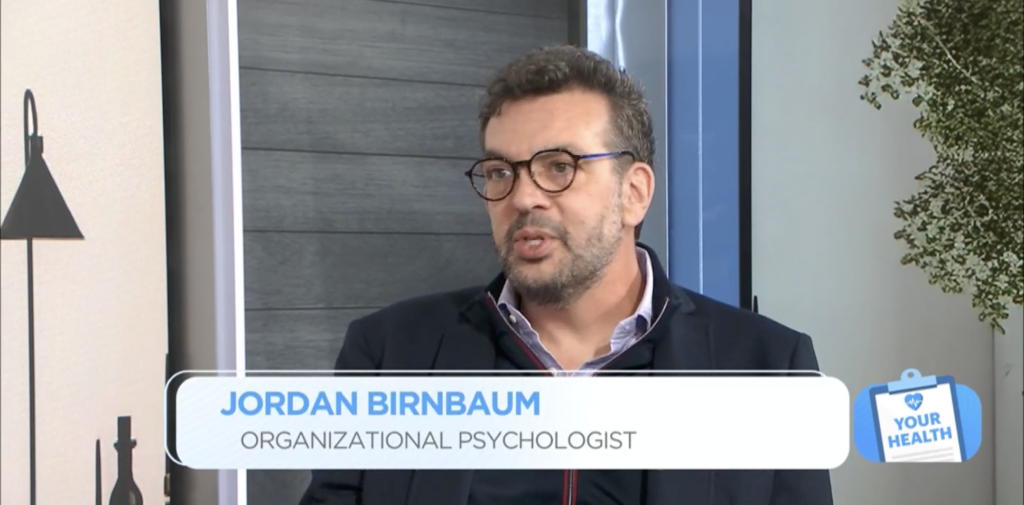
Many of us are often faced with negativity and stress, and it can unfortunately take its toll. But when faced with adversities, it’s important to stay motivated and to thrive. Organizational psychologist and co-founder of The Glinda Group, Jordan Birnbaum, has some ways to thrive “no matter what.”
Why workplace friendships boost engagement
Birnbaum discusses why work friends are so important, why companies/employees should seek out connections, how work friendships foster engagement and productivity and how local businesses can encourage these relationships.
Time for a Mental Refresh
Explore Jordan’s latest insights on workplace behavior, organizational culture, and evidence-based management featured in leading publications.
How to protect yourself from ageism at work
Organizational psychologist Jordan Birnbaum has tips on what to do if you feel you’re being discriminated against.
Radio and podcast appearances
Long-form interviews allow us to go deeper into our subject matter expertise, which we hope inspires a sense of possible and emotional satisfaction.
Proven Steps to Build High-Performing Teams with Laura Martin, CEO, The Glinda Group
Think building a high-performance team means you have to do everything yourself? Laura Martin is here to shatter that myth. The secret isn’t working harder as a leader – it’s getting your team leverage their strengths in ways you probably haven’t considered.
Chasing Jordan Birnbaum: Business Like A Sports Team
In this episode, Chad Sowash and Brian Johnson sit down with Jordan Birnbaum — a behavioral economist, executive coach, and I/O Psychologist — to unpack the surprising parallels between sports and corporate talent management.
Navigating Uncertain Times
Laura Martin is an expert in workplace culture and leadership. As the co-founder and CEO of The Glinda Group, she helps organizations create engaged, high-performing teams using insights from behavioral science. She talked with Bruce about navigating uncertain times.
Laura Martin - Choosing your own adventure
What if the real key to leadership wasn’t authority, but curiosity? In this energizing episode of Back2Basics, Leticia Latino sits down with Laura Martin—founder of The Glenda Group—to explore how choosing curiosity over conventionality has shaped her bold, purpose-driven career.
Unlocking the strategic power of empathy at work
In this episode, Gillian, Michelle, and Jordan Birnbaum explore the evolving role of empathy in the modern workplace. Jordan underscores empathy’s strategic value across various roles, including sales, marketing, and leadership, while also examining how narcissism can obstruct authentic connections.
Redefining Work in a Post-Pandemic World
Tapping into the fresh start effect
How “Back To School” time can be a great time to start something new—besides school.
The Jackie Robinsons of Mental Health
Discussion about how athletes are leading the way in normalizing discussions about mental health.
Achieving your goals.
We discuss strategies for starting and achieving goals around important milestone events, such as going back to school.
Chief Behavioral Economist Dedicates his Life to Teaching and Consulting Others to be Their Best Leaders!
Jordan possesses a unique combination of professional experience and subject matter expertise, making him a highly sought-after speaker, author, interview, and consultant.
Mental Health Practices With Athletes
Discussion about how athletes are leading the way in normalizing discussions about mental health.